
Freddie Jackson – The Voice That Made Romance Sound Timeless
The news of Freddie Jackson’s passing has left me deeply shocked and saddened. Freddie was not simply one of the great R&B vocalists of his generation. For those of us who grew up with the sophisticated soul music of the 1980s, his voice became part of the emotional landscape of our lives. I had the privilege of interviewing Freddie twice, the first time in 2012, not long after he had lost his mother, a woman to whom he had been extraordinarily close. That conversation has stayed with me. There was a vulnerability behind Freddie Jackson that the public rarely got to see. Very little was ever really known about his private life. He belonged to a generation of artists who did not feel compelled to share every corner of themselves with the world. The songs were public; the man largely remained private. But when we spoke about his mother, I sensed the depth of that loss. I have often thought about that conversation over the years, and I am not sure Freddie ever completely recovered from losing her.
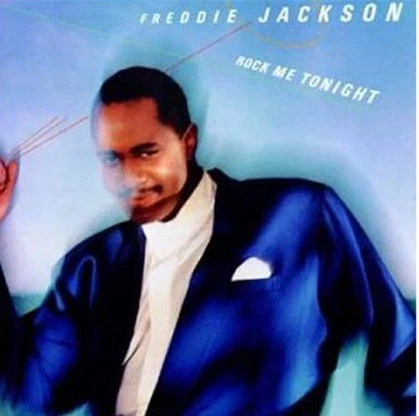
Born and raised in Harlem, Freddie Jackson came from the gospel tradition, singing at White Rock Baptist Church before working the New York club circuit, performing with Mystic Merlin and singing background vocals for Melba Moore. One of the most important relationships in his career was with songwriter and producer Paul Laurence, whom Freddie had known since his church days. When Rock Me Tonight arrived in 1985, it did not merely introduce another talented singer. It announced one of the defining male voices of an era. “Rock Me Tonight (For Old Times Sake)” spent six weeks at No. 1 on Billboard’s R&B chart, and then came “You Are My Lady” — elegant, vulnerable and beautifully restrained — which became his biggest crossover record. His debut album went platinum and earned Freddie two Grammy nominations, but statistics only tell part of the story.
There was something unmistakable about a Freddie Jackson record. The voice could soar, but Freddie rarely needed vocal gymnastics to prove that he could sing. His strength was intimacy. He could make a record feel as though it was being sung to one person rather than millions. Together with Paul Laurence, Freddie helped give new life to the musical language Marvin Gaye had introduced so brilliantly with “Sexual Healing” — sensual soul built around drum machines, synthesizers and space, while never allowing technology to replace emotion. With records such as “Rock Me Tonight,” that vocabulary found a new home in mid-1980s R&B, and many crooners would follow. The combination of programmed rhythms, sophisticated production and an unmistakably human voice became one of the foundations of contemporary romantic R&B, and Freddie Jackson stood right at the centre of it.
What followed was one of the most impressive runs in modern R&B. “Tasty Love,” “Have You Ever Loved Somebody,” “Jam Tonight,” “Nice ’N’ Slow,” “Hey Lover,” “Love Me Down” and “Do Me Again” became part of a remarkable catalogue. Freddie ultimately accumulated ten No. 1 R&B singles, while his first two albums, Rock Me Tonight and Just Like the First Time, both achieved platinum status. At his commercial peak, Freddie Jackson was not merely having hits; he was helping define what Black adult contemporary radio sounded like. Alongside artists such as Luther Vandross, Anita Baker, Peabo Bryson and Alexander O’Neal, he represented an era when sophistication was not considered the enemy of soul. The arrangements could be polished, the musicians immaculate and the production expensive, but the emotion still had to be real. And Freddie’s voice always sounded real.
As musical fashions changed during the 1990s, his presence on the charts diminished. New Jack Swing and later hip-hop transformed R&B radio, and the classic male soul crooner was no longer automatically at the centre of the conversation. But Freddie never stopped being Freddie. He continued recording, performing and carrying that unmistakable voice into new decades. His catalogue survived changing fashions because the emotions at the heart of those records never depended on fashion in the first place. Love, desire, loneliness, vulnerability and regret do not become obsolete.
Perhaps that is also why the news of his passing feels so difficult to process. Having interviewed Freddie twice, I will remember more than the hits. I will remember the man behind them: a very private man, a man whose relationship with his mother clearly meant an enormous amount to him, and a man whose own vulnerability perhaps explains why he could communicate romantic emotion with such extraordinary conviction. We sometimes describe singers as having “soul” when what we really mean is that we believe them. I believed Freddie Jackson. When he sang about longing, you believed the longing. When he sang about losing someone, you believed the loss. And when he sang about love, for those four or five minutes, you believed in that too.
Freddie Jackson passed away on October 5, 2026, only three days after his 70th birthday. The news has affected me deeply. Rather than simply listing his achievements, I want Soulinterviews to remember Freddie through something more personal: his own voice, his own memories and his own words. In tribute to Freddie Jackson, I am republishing my interview with him. Listening to it again now will inevitably feel different, but perhaps that is one of the beautiful things about recorded music — and recorded conversations. People leave us. Their voices don’t.
Rest peacefully, Freddie. And thank you for all those nights, all those songs and all those emotions.

Soulinterviews – The Sound of Emotions